


Events
Highly Interactive SSC Japan 2025 Webinar Encouraged Alumni to Build Careers in Japan through Mentorship
JST and the secretariat would like to extend deep thanks to more than 140 participants worldwide who joined the September 6 webinar and wish to congratulate all SSC Japan coordinators who brought forth the online event flawlessly. The SSC Japan Webinar 2025 “From Exchange to Engagement─Beyond Sakura Science Program: Exploring Higher Studies and Career Opportunities in Japan,” included a 40 minute long Q&A session, where coordinators tried to address many questions. It was one of the most interactive session so far. Many survey respondents asked for similar sessions in the future.

Mr. ITO Sotaro, Deputy Director-General, Sakura Science Program Headquarters, who opened the webinar, explained that JST has invited more than 43,000 young talented people to Japan since 2014 under the Sakura Science Program (SSP), and that all participants of SSP are invited to become members of SSP’s alumni association, Sakura Science Club (SSC). SSC is a platform to promote networking among alumni and it tries to contribute to members’ professional development. Mr. ITO hoped for the event to be a stepping stone for all participants who wish to build their future in Japan.

Sakura Science Program Headquarters
After Mr. ITO’s address, current coordinators of Sakura Science Club Japan (SSC Japan) introduced themselves, starting with Dr. Dyuti from India (SSC Japan President - Assistant Professor, Yamaguchi University). Following Dr. Dyuti, Ms. Nusrat from Bangladesh (SSC Japan Vice President – Ph.D. Student at University of Osaka), Mr. Nico from Indonesia (SSC Japan Vice President – Ph.D. Student at OIST), Ms. May from Myanmar (Ph.D. Candidate, University of Osaka), Ms. Ha from Vietnam (R&D engineer in the semiconductor industry), Mr. Rahul from India (Sustainability Strategist, Rakuten Mobile), Ms. Ju from Myanmar (Ph.D. Candidate, Assistant Professor, Kyoto University), Mr. Sahil from India (CTO at Review inc.), Ms. Huang Wei from China (Ph.D. Student – Hiroshima University) and Ms. Pham Ha Trang from Vietnam (MEXT Research Student, Waseda University) introduced themselves.


Moderated by Mr. Nico, the first session briefed about the Sakura Mentor system, where Mentors based in Japan provide one-on-one consultation through email. The Mentor team consists of former SSP participants who later returned to Japan for study, research, or work. Alumni members may apply to consult a mentor through the registration form on study, research, work, academic culture, job hunting and daily life. Currently, there are eight mentors from different countries, whose profiles are listed on the SSC website Mentor page.
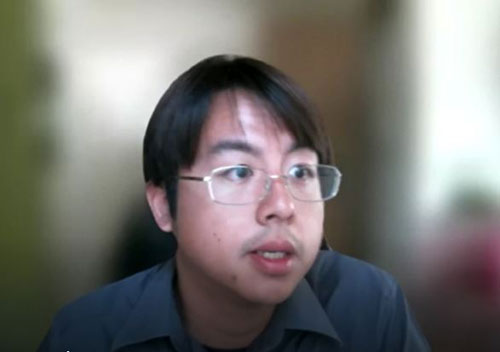


In the next session moderated by Mr. Rahul Maroju, three alumni presented about their paths involving Japan. Ms. Pham Ha Trang (SSP 2021) who served as an SSC coordinator in Vietnam, encouraged the audience to never underestimate any opportunity nor get overwhelmed by thinking that you are not good enough. She emphasized not to shy away. “If you give it a try, your chance is 50/50. But if you give up right away, your chance is zero,” she said. She went through rigorous preparation of the scholarship while doing her thesis at the same time, and she won the MEXT scholarship as a master’s student to Waseda University.
-
 Mr. Rahul
 -
 Ms. Pham Ha Trang
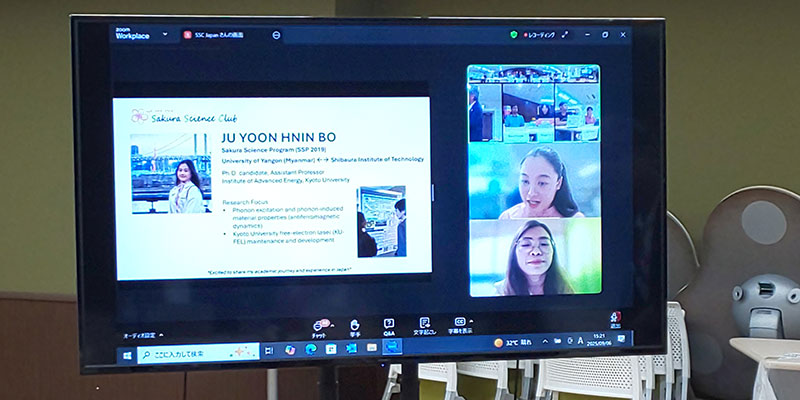
Now, an Assistant Professor at Kyoto University, Ms. Ju Yoon Hnin Bo (Ph.D. Candidate-SSP 2019) came back to Japan in 2020 from Myanmar after winning the highly competitive MEXT Scholarship as a master’s student to Kyoto University. The research environment and the support system at the lab led her to come back. During her Ph.D., a new assistant professor position opened at Kyoto University’s Free Electron Laser (KU-FEL) facility which boasts the widest tunable range. This user-facility attracts scientists domestically and internationally. She operates and maintains its optics /detection systems according to users’ requests, and supports diverse experimental setups. She emphasized that each visiting research project presents unique technical challenges, requiring flexibility and problem-solving daily. Although she did not require any Japanese at all to do her research, she suggested others to at lease have beginner/intermediate Japanese for daily life before arrival.
Ms. May Myat Noe (Ph.D. Candidate-SSP2015), also a MEXT scholar from Myanmar came back to do her master’s degree at the University of Osaka in 2020 and furthered her studies into her doctoral degree. Ms. May recalled how she was faced with a very tight timeline because she had to balance her research and job quest at the same time. As an example of Japan’s structured job-hunting system, she pointed out Entry Sheets (ES: Company-specific job application form requiring you to state job objectives or to write short essays), customized company-specific CVs and taking the SPI Test (Standardized Japanese job aptitude test covering math, logic, and personality assessment). She advised to apply widely. Going to job fairs and internships may give you a bigger perspective. Because she found her current position through her colleagues and seniors, she also recommended utilizing one’s network. Internships are also pathways to full-time positions. Although you can choose to be interviewed in English, “conversational Japanese is recommended to leave a strong impression,” she advised.

In the final Q&A Session, coordinators took up various questions from the audience. Questions and discussion centered around post-doc opportunities in Japan, required level of Japanese language, types of scholarships, career opportunities in academia / industry, and hiring criteria of Japanese companies. After a lively 40-minute Q&A, moderator Ms. Nusrat thanked all the participants. For more advice, she invited the audience to contact the team through the Sakura Mentor platform, explained in the first session.

